Español
  Polski
  Greek
Greek  Italiano
  Turkish
  简体中文
简体中文  English
Unimasses Tech Blog · Function-Driven Development
From Prototype to Production: The Complete Pod Product Development Process
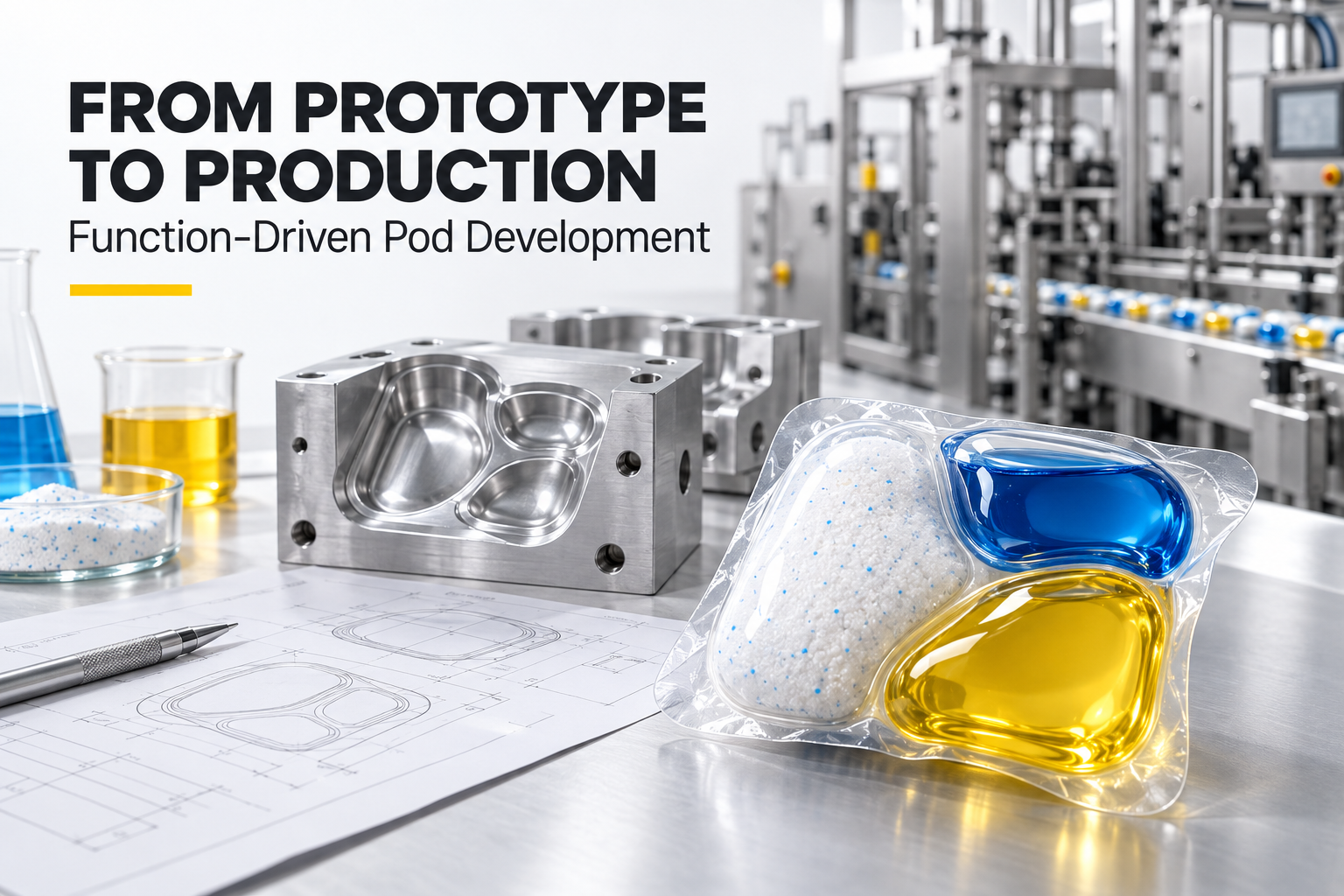
A successful pod begins with the value it creates for the consumer. At Unimasses, function-driven development connects user needs, formulation, chamber architecture and manufacturing to create a product that performs well and can be produced efficiently.
Start with the Function the Consumer Needs
The first question in pod development is what problem the product should solve. That answer establishes the required functions, the formulation and the dose. Only then can the development team determine the number and proportions of the chambers and design an appropriate shape.
Beginning with a fixed shape before analyzing user needs is a fundamental design mistake. It forces the formula and production process to accommodate an appearance that may have little connection to product performance. This is a trap to avoid at the start of a project.
Our development principle: Define the user need, build the formula, establish the chamber structure, and develop the shape within practical manufacturing limits.
Appearance still matters. A distinctive shape can support brand recognition and product appeal. Function-driven development gives that shape a sound technical foundation, so the finished product can deliver its intended benefit at a viable production cost.
Understand What the Pod Actually Does
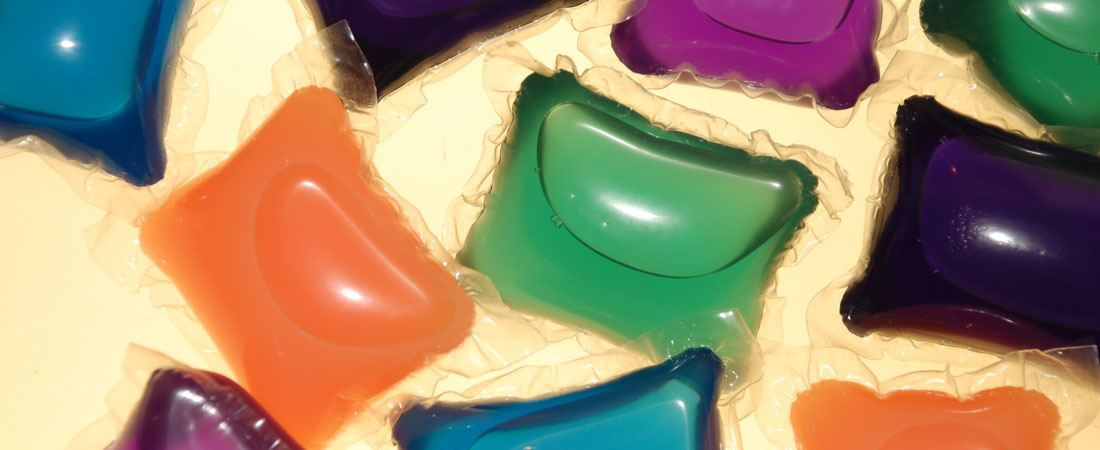
A pod uses water-soluble polyvinyl alcohol film, commonly called PVA or PVOH, to create a temporary storage and delivery carrier. The film contains a measured quantity of ingredients during distribution and handling, then dissolves during use to release them into the wash.
Suitable film grades combine water solubility with the strength, formability and chemical resistance needed for detergent packaging. Those properties must be matched to the formulation and application; chemical resistance is not universal across all ingredients or conditions. [1]
Water dissolution and biodegradation are separate processes. Appropriate PVA films can biodegrade under suitable conditions, but dissolving in water does not mean that biodegradation has already occurred. Film selection and compatibility testing therefore belong within product development. [2]
The active ingredients create the consumer benefit. The carrier makes their storage, dosing and delivery convenient. When the ingredients reliably solve a problem that consumers value, the product has a foundation for repeat purchases and sustainable commercial value.
1. Translate Consumer Needs into a Formulation
A useful brief identifies the target users, application, washing conditions, expected results and acceptable cost per use. For a laundry pod, that might include fabric types, common stains and wash temperatures. For a dishwasher pod, it might include food residues, water hardness, machine size and cycle selection.
The development team translates those requirements into measurable performance targets and selects an appropriate combination of ingredients. The formulation must deliver the required result at the intended dose while remaining suitable for storage, packaging and production.
Laboratory samples help establish whether the formula meets the brief. Performance, stability and film compatibility are evaluated together, with revisions made before the design is committed to production tooling. Applicable market requirements and proposed product claims also form part of the brief.
2. Determine Chamber Numbers and Proportions
Once the formulation is established, the team determines how its components should be arranged. Chamber numbers follow formulation compatibility and delivery requirements. A separate chamber is useful when it provides a technical benefit, such as keeping particular ingredients apart during storage.
There is no rule that every function requires its own chamber. Several ingredients can share one chamber when they are compatible, while ingredients supporting the same function may need different storage environments.
Chamber proportions must reflect the actual volume needed for each component. A formula ratio expressed by weight cannot simply be copied into a geometric ratio: liquid density, powder bulk density, usable cavity volume and the space required for reliable filling all affect the layout.
The design output: A chamber structure that accommodates the required dose and ingredient separation, with proportions derived from the formulation and filling requirements.
3. Design the Shape Around Manufacturing Reality
The chamber structure provides the basis for the external shape. Designers and engineers then work together to balance visual identity with film forming, filling, sealing and the capabilities of the intended equipment.
For example, a liquid chamber that is too small or excessively narrow and elongated may leave insufficient access for a filling nozzle. It can make accurate dosing more difficult and increase the risk of liquid reaching the sealing area. A visually attractive cavity can therefore become a source of unstable production.
Engineers also assess cavity depth, film stretching, transitions between chambers and the sealing space around them. These details influence whether the shape can be formed and sealed consistently at the required production rate.
How We Work with Customer-Designed Shapes
A customer sketch is valuable input for understanding brand preferences. However, a design created without manufacturing experience needs engineering review before it becomes a production specification. Insisting on an exact shape without that review can transfer avoidable problems into tooling and mass production.
When a design presents filling or forming difficulties, the team adjusts the chamber dimensions or overall geometry while retaining the important brand features wherever practical. Engineering feedback may also lead to revisions in chamber proportions or the formulation. The process is iterative, with consumer performance and production feasibility guiding each decision.
4. Turn the Approved Design into Production Tooling
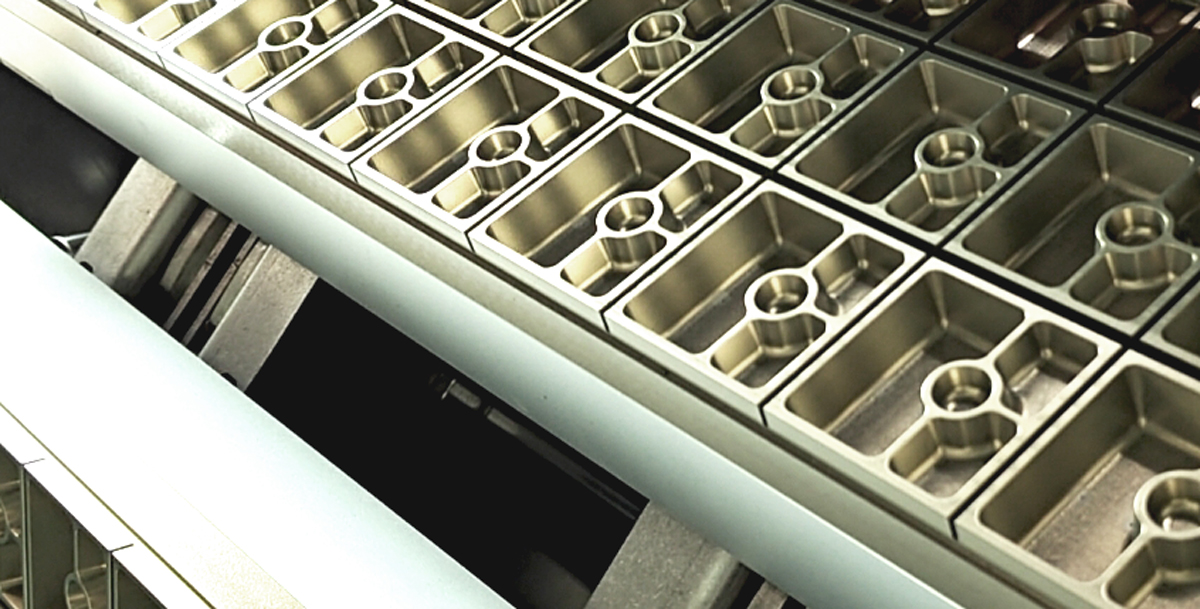
After the formulation and engineering design have been reviewed, the factory prepares drawings and manufacturing specifications. In our custom tooling workflow, these are sent to a CNC machining partner, where five-axis CNC machining is used to produce the required molds.
The tooling must reproduce the approved cavity geometry and fit the intended production equipment. Once the molds return to the factory, the team checks them and installs them on the machine for commissioning.
A finished mold is an important milestone, but production readiness must still be demonstrated on the equipment. Trial runs show how the design behaves with the actual film, formulation, filling system and operating settings.
5. Commission the Line and Validate the Finished Pod
During commissioning, engineers adjust film forming, ingredient dosing, sealing and cutting to achieve consistent output. The prepared ingredients are filled into their designated cavities, the film is sealed, and the individual pods are separated.
Trial products are checked for dose accuracy, chamber integrity, leakage, dissolution and the intended cleaning performance. Stability assessment considers the complete product, including the relationship between the ingredients, film and final packaging.
The goal is a repeatable process that produces a functional, intact pod at a commercially practical rate. If trials reveal a problem, the team resolves it through formulation, geometry or process changes before routine production begins.
From Production Line to Retail Shelf
Validated pods are packed into the agreed retail packaging. Packaging must help protect them during storage and distribution and provide the required product information and usage instructions. Batch identification, quality checks and packing controls complete the transition from a development sample to a shelf-ready product.
What Each Development Stage Must Deliver
| Stage | Required Output |
|---|---|
| User requirements | A defined application, measurable consumer benefit and realistic commercial target. |
| Formulation | An ingredient system and dose supported by performance, stability and compatibility evaluation. |
| Chamber architecture | The necessary chamber number and usable volumes, based on formulation ratios and ingredient properties. |
| Shape and engineering | A design that supports the brand and can be formed, filled and sealed on the intended equipment. |
| Tooling | Manufactured and inspected molds matched to the approved design and production line. |
| Commissioning | Validated operating settings and finished pods that meet the agreed quality and performance requirements. |
| Packaging and production | Consistent, protected and correctly labeled products ready for distribution. |
Technical References
[1] Kuraray, Water-Soluble PVOH Film for Detergent Packaging: film properties, unit-dose applications and sealing methods.
[2] MonoSol, AquaFilm Water-Soluble Film: dissolution and biodegradation under appropriate conditions.