Español
  Polski
  Greek
Greek  Italiano
  Turkish
  简体中文
简体中文  English

In the long journey of detergent R&D, every formulator dreams of packing all the most efficient and advanced cleaning agents into a single pouch. However, reality is often harsh: many active ingredients act like "oil and water"—once they meet, compatibility issues arise, leading to discoloration, degradation, clumping, or even total loss of efficacy.
Today, using a straightforward comparative experiment from our lab, we will dive into a seemingly simple yet critical design in laundry pod formulation: Dual-Powder Pods. We’ll explore how this design enhances stability and delivers superior end-results without increasing (and sometimes even reducing) raw material costs.
Lab Spotlight: From White to Brown—Visual Evidence of Incompatibility
Let’s examine a high-intensity stress test conducted in our laboratory. We tested the powder components of a powder-liquid hybrid pod currently under development, divided into two groups:
-
Component A: Primarily Sodium Percarbonate (Oxygen Bleach).
-
Component B: Enzyme preparations and auxiliary materials.
The components were sealed in PVA film and placed in an oven at 45°C for 24 hours for a qualitative observation of appearance changes.
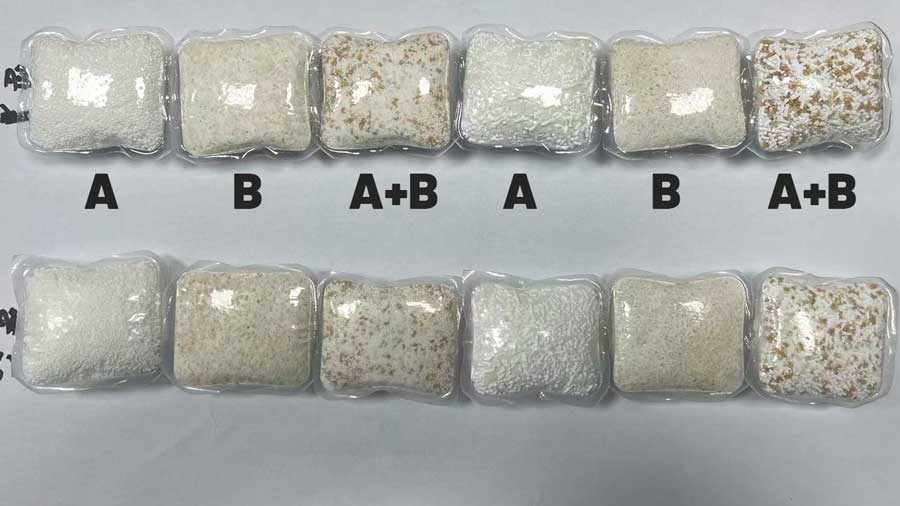
The results show two starkly different scenarios:
-
Top Row (Left A & B): Stable in Isolation. Components A and B were wrapped separately. Component A remains pure white, and Component B is pale yellow. Both stay stable with smooth surfaces and no abnormalities.
-
Top Row (Left 3): The Conflict. When A and B were forced into a mixture and compressed (simulating a single-chamber state), the change was dramatic. Distinct brown spots and deep discoloration appeared in the once-white mixture. This isn't just a color blend; it’s a classic chemical reaction triggered by conflicting active ingredients.
-
Bottom Row: Verification. The repeated experiment yielded identical results: Independent stability vs. Mixed discoloration.
Experimental Conclusion: This visual reaction irrefutably proves that Components A and B are chemically incompatible.
Deep Dive: The Chemistry and Physics Behind the Conflict
Direct physical contact leads to immediate reactions, ruining the product's aesthetics and, more importantly, signaling the degradation of cleaning actives. Our analysis indicates that the Enzymes are the victims here. Preliminary findings suggest that the dextrin within the enzyme preparation oxidized in the presence of the bleach. While specific activity loss requires further titration, the browning alone is a fatal blow to product shelf-appeal.
Why do "gentle" cleaning agents react so violently? In a homogenous formula (especially dry powder or hybrid mixes), several "killers" are at play:
-
Extreme pH Conflicts: Bleaches like Sodium Percarbonate require high alkalinity for stability, while certain enzymes, fragrances, or surfactants degrade or oxidize rapidly in such environments.
-
Redox Reactions: Strong oxidizers (bleach) are the usual suspects, attacking sensitive components and leading to browning and potency loss.
-
Moisture Migration: Even in "dry" powders, varying hygroscopicity causes micro-moisture to gather at contact points, triggering localized reactions (hence the "spots" seen in the photos).
In these cases, a single-chamber formula is forced to "compromise." Formulators must either add expensive stabilizers to suppress reactions or use milder (and often less effective) ingredients.
The Dual-Chamber Logic: The Secret to "Free" Stability
The Dual-Powder Pods design (Dual-Powders Combo Pouches) is not a cosmetic trend; it is a functional technology driven by performance.
The principle is simple:
-
Physical Isolation: Using PVA film to create independent compartments.
-
Micro-Environment Optimization: Placing "clashing" ingredients (e.g., alkaline bleach in Chamber A, pH-sensitive enzymes/fragrances in Chamber B) in their own ideal environments.
-
Just-in-Time Release: Ingredients only meet once the film dissolves in the wash water, where they work synergistically without having depleted each other during storage.
The "No-Cost" Performance Revolution: Achieving 1+1 > 2
Many perceive multi-chamber design as "complex and expensive." However, from a product lifecycle perspective, it actually lowers the barrier to high performance:
-
Optimized Formula Utilization = Cost Efficiency: In a single chamber, we often sacrifice active efficiency (e.g., lowering enzyme dosage) just to maintain stability. Multi-chamber design allows the use of "raw," high-efficiency ingredients without fear of degradation. You get more "cleaning power per dollar."
-
Extended Shelf Life = Lower Operational Risk: Discoloration and potency loss lead to shorter shelf lives and consumer complaints. Multi-chamber storage significantly extends stability, reducing the financial risk of expired or underperforming stock.
-
Visual Premium & Marketing Value: The sophisticated look of a multi-chamber pod communicates "Advanced Tech" to the consumer. This perceived value often covers the marginal increase in manufacturing costs and builds brand equity.
From "Managing Conflict" to "Creating Excellence"
This experiment highlights a fundamental flaw in mixed formulations but offers a path to superior performance.
Multi-chamber storage is a functional tool with immense commercial value. By solving incompatibility at the source, it frees the formulator to deliver a more powerful, reliable product. As dual-powder filling technology matures and scales, these high-performance solutions will rapidly take over global shelves.